
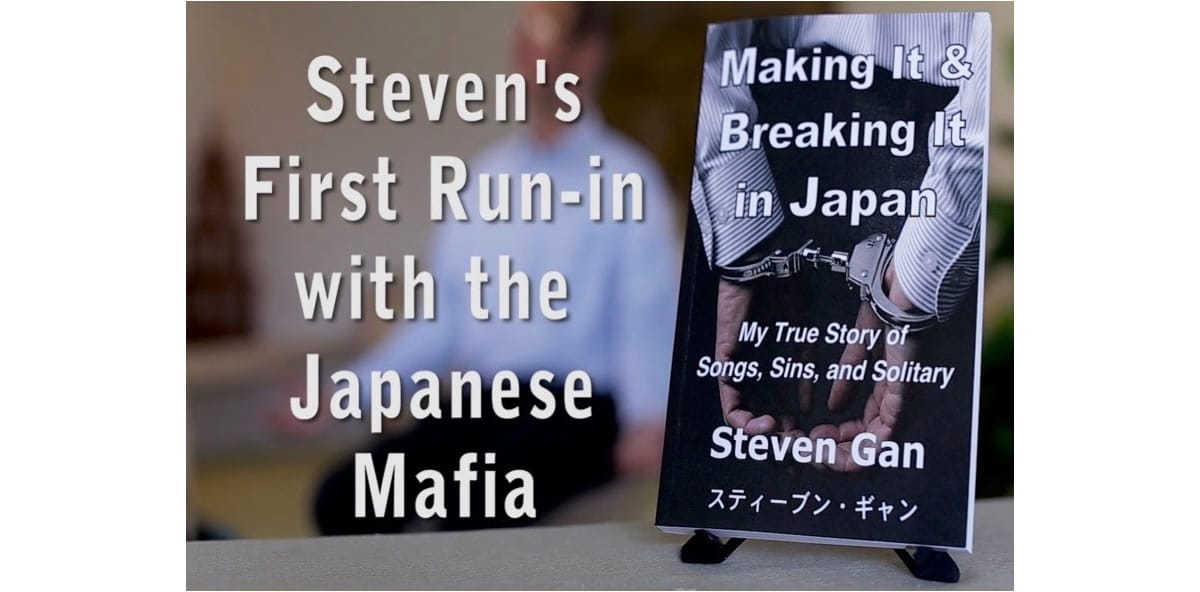
A revised excerpt from the book, Making It & Breaking in Japan – My True Story of Songs, Sins, and Solitary.
Having lived in Japan for 15 years and operated my own debt collection agency in Tokyo for 12 years, I’m often asked about the differences between collections in Japan and the US. Well after performing both consumer and commercial collections in both countries for several years, I would have to say that performing collections in Japan is infinitely easier.
With all of my years of collection experience in Japan, I discovered a few important cultural perspectives as to how the Japanese perceive owing money.
Most Japanese are embarrassed about not having the ability to pay their debts. They want to pay, they have the volition to pay, but in most cases they may not have the ability to pay.
The overwhelming majority of Japanese are extremely polite on the phone. In the twelve years I did collections in Japan, I think there were less than ten people who I felt were ever rude or obnoxious to me. Even the most manipulative type of debtor usually spoke politely to me.
A good number will try to avoid discussing the debt situation any longer than they have to and will usually enter into an agreement to pay by installments fairly quickly to end an unpleasant conversation. Subsequently, nearly all of them will break their initial promises to pay, which requires a few follow-up calls and reminders until that first payment is finally forthcoming.
As a foreigner (gaijin) doing collections in Japan, calling on Japanese debtors, and negotiating with them in Japanese about their debt obligations was a singular experience. Perhaps for several years I had to believe I was the only gaijin collector in the country.
Being a gaijin, I did have an advantage over the Japanese collectors in my office. Whenever I initially called a Japanese debtor they were startled upon hearing a voice with a foreign accent over the phone talking about an unpaid account. I could hear their voice hesitating or quivering as if to say, “Why on earth is a gaijin calling me?” Some debtors asked if I was calling from America, or if I was even a member of the overseas mafia.
I would immediately inform them I was calling from my office in Tokyo and that I greatly appreciated the opportunity to speak with them. Here’s a typical conversation I would have had with a Japanese debtor:
Kobayashi: Hello, this is Kobayashi.
Steve: Kobayashi-san, this is Steven Gan of the International Credit Management Association (slight bow over the phone). As always you are greatly appreciated (standard Japanese greeting). I know you’re very busy but is now a good time to talk with you?
Kobayashi: Oh yes (with a bewildered tone to the voice). I received your letter the other day and I am so terribly sorry that I didn’t call you. Please forgive me.
Steve: No problem at all. As I had mentioned in our letter, there’s an outstanding balance of 480,000 yen (US $4,500) owed to ABC Credit Card. With all due respect, I would like to kindly ask you, when might you possibly be able to consider making your payment?
Kobayashi: Yes, yes, yes (hai, hai, hai) I completely understand, and I would like you to know first that I have every intention of fulfilling my obligation and paying my debt, which is unconscionably delinquent. There’s no excuse for it and I feel just horrible.
Steve: I really appreciate your acknowledgement of the situation. Would you kindly help us by making your payment in full very shortly?
Kobayashi: From the bottom of my heart I wish I could say yes to you, but I have to tell you that my financial situation is so dire that I can barely make ends meet now.
Steve: I completely understand and appreciate your honesty. What would you be able to afford and at the same time would be reasonable for ABC Credit Card to accept?
Kobayashi: If possible, and with the utmost sincerity, I would like to pay this obligation off in eight payments of 60,000 yen ($500) per month starting at the end of this month.
Steve: Oh Mr. Kobayashi, I really appreciate your kind offer but do you think it’s possible to pay this obligation off within four payments of 120,000 yen ($1,000) per month?
Kobayashi: Mr. Gan, my situation is so tight and I really don’t want to make any promises that I won’t be able to keep. As it is now, I feel so ashamed about not being able to pay this debt as well as several other debts.
Steve: Would you possibly consider six payments of 80,000 yen ($700) per month? Since the debt is already about one year old, I don’t think that ABC Credit Card can wait much longer.
Kobayashi: Then I will try to do six payments of 80,000 yen per month. Please understand Mr. Gan that I am taking the last bit of food out of my mouth for ABC Credit Card.
Steve: Your heartfelt cooperation is tremendously appreciated and I shall convey this to ABC Credit Card.
Kobayashi: Thank you so much for your call Mr. Gan. I look forward to working with you in this matter and please convey my sincerest apologies to ABC Credit Card.
Steve: Thank you again Mr. Kobayashi for your cooperation.
Kobayashi: Thank you very much.
Steve: Thank you so much.
Kobayashi: Thank you and please feel free to call me again.
Steve: Goodbye (with another little bow over the phone).
Kobayashi: Goodbye.
Steve: (Always waited until they hung up their phone first before I would hang up mine.)
The upshot of this conversation is that about 70% of all Japanese debtors would enter into an agreement to pay by installment during the first call and about 90% of them would break their promise when it came time to make the first installment. By about the third follow-up call I would finally receive payment and most payment schedules from that point on would be reasonably upheld.
During my collection experiences, there were times I felt terrible about some of the situations a few debtors found themselves in. In these cases, instead of pursuing an outstanding account against the debtor in our usual assembly-line manner, I decided to take some different approaches that would be considered quite unorthodox throughout the worldwide collection industry.
There were cases when Japanese debtors who had every intension of paying their debt obligations, couldn’t because they were unemployed with no source of income. When I ran into this kind of situation I would often ask if they were actively looking for employment. In most instances they were, but after Japan’s economic bubble burst in 1991 and the economy remained stagnant throughout the rest of the ‘90’s, many people, particularly those in their fifties and sixties, could no longer find work. They were either deemed too old or too expensive to hire.
In trying to understand an unemployed debtor’s level of desire to work, some of the questions I asked included:
- How many resumes are you sending out each day?
- Do you call any companies directly to see if they might be hiring?
- How well are you leveraging your networks to try and get introduced?
- Are you available to work in any field including jobs that require a lot of manual labor?
For me, if the debtor was willing to do any kind of job then it was possible I might be able to help them gain employment. For this kind of “Debtor Employment Assistance Program” to work, I needed:
(1) The debtor to come into my office and together we would work on their resume. Just as I was previously helping many Japanese candidates to find a job through our resume consulting service, I decided to utilize this same service for debtors who needed a resume that made their skills and accomplishments shine through.
(2) A relationship with about five different employment, executive search, and day labor agencies to where I could introduce a debtor based upon their skills and experience level.
(3) The creditor’s permission so that there would be no conflict of interest.
(4) An agreement by the new employer that a small portion of the debtor’s salary would be paid to us in order to begin paying off the original debt.
I’m not sure how many debtors we helped through this kind of approach, but it must have been a few dozen. As you can imagine, when a fifty-five year old man who has been out of work for a few years finally gets the chance to start working again, he has a renewed sense of hope for his life, the well being of his family, and the future.
I’ll never forget the time when one gentleman, Mr. Tachibana, showed up at my office with his three kids who were ten, eight, and five years old. Mr. Tachibana had fallen on hard times. He had lost his job, his home and was living in his car with his three kids. Tragically, his wife had also passed away a few years earlier and his youngest son had a serious case of asthma. Plain and simple, he was down on his luck. Finding a job where he was able to take care of his kids and work at the same time was challenging.
Mr. Tachibana had an unpaid mobile phone bill of about 220,000 yen (about $2,000) and through one of his relatives I was able to get in touch with him. I appreciated him coming in and explaining his hardships. I asked if he was actively seeking employment and he responded with a resounding “yes.” He then looked at me as though I was the messiah who was going to lift him out of his economic and emotional black hole.
When I told him about our Debtor Employment Assistance Program, he was excited and told me he would do any job as long as it either paid enough for someone to watch his kids, or have his kids in the same location while he worked.
I also mentioned I knew of a small trucking company that could use his help delivering small packages in his car throughout Tokyo. Again, his eyes lit up with tremendous hope and after a few phone calls I sent him on his way to the trucking company where he was immediately put to use making deliveries.
About two weeks after Mr. Tachibana started working at his new job, I received a payment of 10,000 yen ($100) from his employer that went towards his mobile phone bill, knowing full well that at that rate it would take almost two years to repay the debt. Yes, it was a long time to pay off a relatively small amount of money, but in the end it was better than nothing.
Six months into the job, Mr. Tachibana was hired by the company to work full time, and after two years he was promoted to vice president. At each promotion, the amount to pay off the original debt also increased and it was settled within a year.
Every time we assisted an unemployed debtor in finding a job, we not only brought that individual back from the brink of economic and moral despair, but also helped them to transition back into being a constructive, productive, and contributing member of society. It was times like these when I was proud to think of my debt collection agency as being a “socially responsible and contributing” member to Japan’s well being.
Bio of Steven Gan
Steven Gan was the founder and president of Advance & Associates Co., Ltd. in Tokyo from 1992 – 2004. Advance & Associates was the first company to create and implement the before and after sales total credit risk management product line system in Japan.
Through numerous articles, publications, presentations, and television appearances, Steve greatly deepened the awareness and understanding of the importance of sound credit risk management throughout Japan.
Steve recently wrote the book, “Making It & Breaking It in Japan – My True Story of Songs, Sins, and Solitary,” which has become a best seller in the areas of Japanese Culture, Business in Japan, and Japanese Criminal Justice. Please view the promotional video at:
https://www.youtube.com/watch?v=Zw0l3qPjsCQ
Steve is a native of Chicago, Illinois, graduated from the University of Illinois with a BS in Electrical Engineering, and graduated from the Thunderbird – Garvin Graduate School with a Masters of International Management. Mr. Gan is also a Certified Public Accountant, Certified Credit Executive, and a Licensed Insurance Provider. Finally, Mr. Gan has been the only foreigner to pass the Japanese Insurance Licensing Exam.
By Steven Gan
President
Stellar Risk Management Services, Inc.